

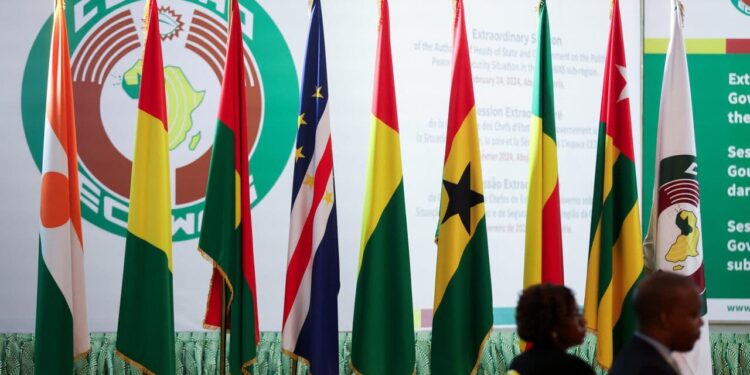
Abuja – The Economic Community of West African States (ECOWAS) announced on Thursday that it has suspended Guinea‑Bissau from all its decision‑making bodies following a military coup on Wednesday. The regional bloc condemned the takeover and called for the immediate restoration of constitutional order, warning that sanctions may follow.
The decision was made during an Extraordinary Virtual Session of the ECOWAS Mediation and Security Council, chaired by Sierra Leone’s President Julius Maada Bio. Participants included the presidents of Cabo Verde, Ghana, Liberia, Nigeria, Senegal and Sierra Leone, as well as the vice president of Côte d’Ivoire. Benin, The Gambia and Togo were represented by their foreign ministers. Also present were ECOWAS Commission President Omar Alieu Touray, African Union Commission Chair Mahmoud Ali Youssouf, UNOWAS head Leonardo Santos Simão, Guinea‑Bissau’s foreign minister and ECOWAS’ special envoy on terrorism.
The Council reviewed a detailed report from the ECOWAS Commission and expressed serious concern over the turmoil in Guinea‑Bissau despite strong democratic participation in the November 23 presidential and parliamentary elections. ECOWAS denounced the November 26 coup and rejected any attempt to undermine the electoral process or thwart the expressed will of voters.
“The Council expressed serious concern over the turmoil unfolding in Guinea‑Bissau despite what they described as the strong democratic participation shown during the November 23 presidential and parliamentary elections,” the statement read. “ECOWAS denounced the November 26 coup and rejected any attempt to undermine the electoral process or thwart the expressed will of voters.”
The bloc demanded that the coup leaders allow the National Electoral Commission to announce the official results of the November polls without interference and called for the immediate and unconditional release of all detainees, including President Umaro Sissoco Embaló, election officials and political figures reportedly held by the mutinous soldiers. It emphasized that the coup leaders are personally and collectively responsible for protecting civilians, detainees and public property.
Citing the ECOWAS Protocol on Democracy and Good Governance, the Mediation and Security Council formally suspended Guinea‑Bissau from participating in ECOWAS decision‑making until constitutional rule is fully restored. To facilitate mediation, ECOWAS tasked President Julius Maada Bio with leading a High‑Level Mission to Bissau, joined by Togo’s President Faure Gnassingbé, Cabo Verde’s President José Maria Neves, Senegal’s President Bassirou Diomaye Faye, and the ECOWAS Commission President.
The Council urged Guinea‑Bissau’s armed forces to return to their barracks and uphold their constitutional duties and instructed the ECOWAS Stabilization Support Mission in Guinea‑Bissau (ESSMGB) to continue safeguarding state institutions during this period of instability. Reaffirming its commitment to monitor the situation closely, ECOWAS warned that it may employ all available regional mechanisms—including sanctions—against individuals or groups responsible for disrupting the electoral process. The bloc stressed that it remains fully engaged with regional and international partners to ensure the rapid restoration of democracy in Guinea‑Bissau.