

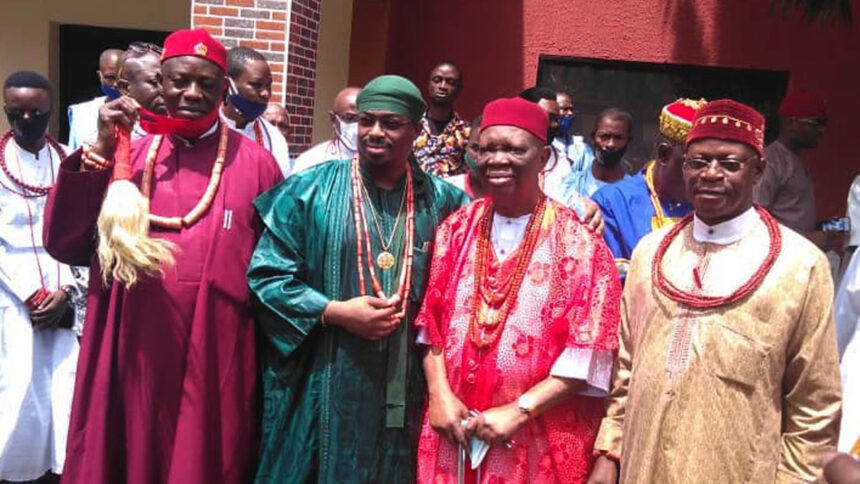
A heated supremacy battle has erupted within the Delta State Traditional Council between the Forum of Urhobo Kings, known as Ukoko r’ivie (FUK), and the Traditional Chiefs of Urhobo Land Association (TCULA) over the existence of parallel chieftaincy associations.
FUK, under the leadership of His Royal Majesty Dr Emmanuel Sideso, Abe I, the Ovie of Uvwie Kingdom, issued a ban on what it described as “parallel chieftaincy associations” in Urhobo land. The ban was announced by the group’s spokesman, His Royal Majesty Obukowho Monday Whiskey, Udurhie I, the Ovie of Idjerhe Kingdom, who declared that no association called the Traditional Chiefs of Urhobo Land Association exists and that no Urhobo chief may belong to or form a chieftaincy association outside his kingdom.
TCULA, however, has rejected the ban as null and void and unconstitutional. Its National President, Chief Omene, said the prohibition is unenforceable because only the government has the authority to dissolve a legally registered association. He emphasized that TCULA is duly registered with the Corporate Affairs Commission (CAC) and operates within the confines of the law.
“The association will continue to exist. Only the government has the power to dissolve an association. TCULA is registered, and the government is aware of it. They don’t have the right to disband it,” Omene said.
He added, “Nigeria has a constitution, and it is binding on everyone. You cannot wake up and take actions that are against the constitution. Freedom of association is guaranteed. If they think they have such powers, let them try it. We will take them to court.”
Chief Omene further argued that traditional rulers lack the authority to strip chiefs of their titles, noting that chieftaincy matters are regulated by the state government. “My king does not have the right to disrobe me. Once a staff of office is given, it cannot be withdrawn arbitrarily. The same applies to chiefs. When a kingdom confers a chieftaincy title, the state government issues a certificate. Only the state government can withdraw such recognition,” he explained.
Expressing disappointment over FUK’s directive, Omene accused the Urhobo kings of selective intervention in critical matters affecting the Urhobo people. “When the Urhobo Progress Union (UPU) was being formed, these same kings fought it. During the Okuama crisis, did they issue a communique? When Urhobos were killed in Warri, did they speak? During INEC delineation in Warri, did they say anything? No,” he alleged.
Despite the opposition from FUK, the TCULA leader expressed confidence in the resilience of his members. “Our members are rock solid. They are not moved by this action,” he said, and added that the traditional rulers were hesitant to confront issues involving neighboring ethnic groups. “They are afraid of the Itsekiri and Ijaw kings,” Omene added.
The dispute highlights a broader tension between traditional authority and constitutional rights within Delta State as the two factions prepare to contest the legitimacy of their respective claims in the courts.