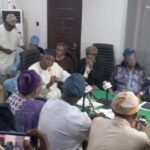


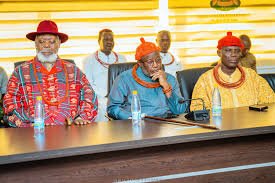
Yenagoa, Bayelsa State – Bayelsa State Governor, Senator Douye Diri, has urged the Ijaw ethnic nationality and the Ijaw National Congress (INC) to maintain their push for the creation of additional states, beyond just Bayelsa. Governor Diri made this charge on Friday during the 2026 INC national convention held at the Ijaw House in Yenagoa.
He implored his kinsmen not to waver in their demand for two more states out of the original three the ethnic group had initially agitated for. The Bayelsa helmsman also affirmed his neutrality in the INC presidency race, stating he had no preferred candidate among the five contestants.
Governor Diri reiterated his advocacy for the practice of true and fiscal federalism in Nigeria, describing the current imbalanced structure as “unitary federalism.” He argued that states, including Bayelsa, would experience greater development if they had full control over their resources and contributed taxes to the federal government.
He reflected on past efforts, saying, “We have tried. Today, we have one state (Bayelsa). The INC, under the leadership of Chief Joshua Fumudoh, asked for three, which are Oil Rivers, Bayelsa and Toru-Ibe states. This means we have two additional states that must be pursued by the Ijaw nation and the INC. So, it is not yet uhuru.”
The Governor emphasized the long-term nature of this struggle: “This is a struggle we must continue and if we cannot achieve it in our time, we will hand it over to our children. Our land and waters have nourished this nation and fuelled its economic activities and yet for too long we have borne the unfortunate environmental damage and social disadvantage.” He further identified pressing challenges, stating, “Economic inequities, environmental degradation and infrastructural neglect remain our pressing challenges that require our local and national resolve to redress. The challenges we face are formidable but I have no doubt that our sons and daughters possess the resilience and indomitable spirit to overcome them.”
Diri advised contestants for various positions in Saturday’s election to prioritize the overarching interests of the ethnic nationality over personal considerations. He commended the outgoing INC President, Prof. Benjamin Okaba, and his executive council for their leadership, particularly for their partnership with the government in securing formal admission for the Ijaw nation into the United Nations’ Unrepresented Nations and Peoples Organisation. He also tasked the incoming leadership with continuing the revival of Ijaw cultural values and language to fulfill the dreams of the founding fathers.
In his address, Prof. Benjamin Okaba called for strategic global engagement in the Ijaw struggle, highlighting that the ethnic nationality remains Nigeria’s economic backbone despite years of neglect. He advocated for a shift from protest-driven advocacy to stronger global engagement and described the convention as a milestone for leadership renewal and a re-assessment of the organization’s direction. Okaba also noted that despite being a major contributor to Nigeria’s oil-driven economy, the Ijaw nation continues to endure environmental degradation and infrastructure neglect. The INC President announced new strategic initiatives, including a Territorial Mapping Project aimed at digitally documenting Ijaw ancestral lands to support environmental monitoring and resource negotiations. To strengthen unity, he added that the INC has registered 15 affiliate groups to collectively amplify the Ijaw voice on national and international platforms.
Dignitaries present at the event included former Bayelsa deputy governor, Peremobowei Ebebi, Speaker of the House of Assembly, Rt. Hon. Abraham Ingobere, other lawmakers, the Head of Service, Dr. Ebiye Sawyer, Commissioners, the All Progressives Congress state chairman, Hon. Warman Ogoriba, local government chairmen, chairman of the state traditional rulers council, King Bubaraye Dakolo, and royal fathers from Bayelsa, Delta and Rivers states, as well as top government functionaries and stakeholders.