

The Nigerian National Petroleum Company Limited has signed a Memorandum of Understanding with two Chinese companies for the restart, operation and expansion of the Warri and Port Harcourt refineries, in a move aimed at reviving Nigeria’s long-dormant state-owned plants.
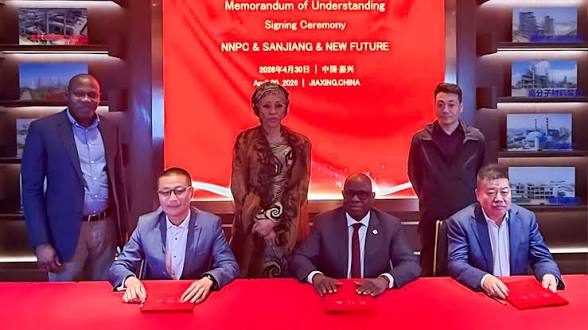
The agreement was executed on April 30, 2026, in Jiaxing City, China, by NNPC Group Chief Executive Officer Bashir Bayo Ojulari, Chairman of Sanjiang Chemical Company Limited Guan Jianzhong, and Chairman of Xinganchen Fuzhou Industrial Park Operation and Management Co. Ltd Bill Bi. NNPC Chief Corporate Communications Officer Andy Odeh disclosed the deal in a statement on Monday.
Under the MoU, the Chinese partners will support completion of outstanding rehabilitation work at both facilities and take part in their operation and maintenance to achieve sustainable performance. The partnership will also explore expansion and upgrade of the refineries to meet cleaner fuel standards, improve profitability and boost petrochemical production capacity. It is further expected to support development of gas-based industrial hubs around the facilities.
Speaking after the signing, Ojulari described the agreement as a major milestone following months of negotiations. “All parties recognise mutually beneficial opportunities for the development and long-term sustainability of NNPC’s refining assets,” he said. He added that the MoU represents a key step toward securing technical partners for the rehabilitation and expansion of the country’s refineries, while also unlocking opportunities in petrochemicals and gas-based industries.
The deal is expected to pave the way for a Technical Equity Partnership aimed at completing ongoing rehabilitation works and ensuring efficient operations. Ojulari stressed that NNPC is not selling the refineries but is willing to relinquish a portion of equity to partners with proven refinery operating experience. “We are not selling the refineries, but we are prepared to relinquish some equity so that partners have skin in the game,” he said at the Nigeria International Energy Summit 2026 in Abuja.
Ojulari said an internal review carried out shortly after he assumed office in April 2025 showed the refineries were running at huge losses, with high operating costs and heavy spending on contractors while processing volumes remained low. “The goal is to establish a self-financing, sustainable refinery system that runs like a business,” he said. He noted that capacity utilization had stalled at 50 to 55 percent despite billions spent on maintenance.
The NNPC chief revealed he had met with one of the potential investors before the MoU signing. “I’m just coming from a meeting with one of the potential investors. They are going to the refinery tomorrow to inspect. It’s a Chinese company that has one of the biggest petrochemical plants in China,” Ojulari said, without naming the firm at the time.
Nigeria has struggled for decades to rehabilitate its aging refineries, which have a combined 445,000 barrels per day capacity across Port Harcourt, Warri and Kaduna. The plants have operated far below capacity, forcing Africa’s largest crude oil producer to rely heavily on imported fuel. The Port Harcourt Refinery comprises two units with a combined 210,000 bpd capacity, while Warri has 125,000 bpd.
The new model prioritizes industrial partnerships based on operational performance and sustainable profitability, Ojulari said, adding that three elements are essential to restarting the refineries: financing, a competent engineering procurement and construction contractor, and world-class operational capacity.
The partnership framework also contemplates expanding the refineries’ petrochemical capacities and harnessing gas and downstream opportunities through the development of co-located industrial hubs. Ojulari said NNPC’s board has approved a strategy to bring in refinery operators with proven expertise rather than contractors.
The agreement follows more than six months of concerted engagement between the technical and management teams of NNPC and the two Chinese partners. “All parties recognise mutually beneficial opportunities for the development and long-term sustainable profitability of NNPC’s refining assets in Nigeria, and the collective weight required for success,” Ojulari noted.
The move comes as the Dangote Refinery reaches its full 650,000 bpd nameplate capacity, offering what Ojulari described as “breathing space” for domestic fuel supply while NNPC works to restore its own plants.