

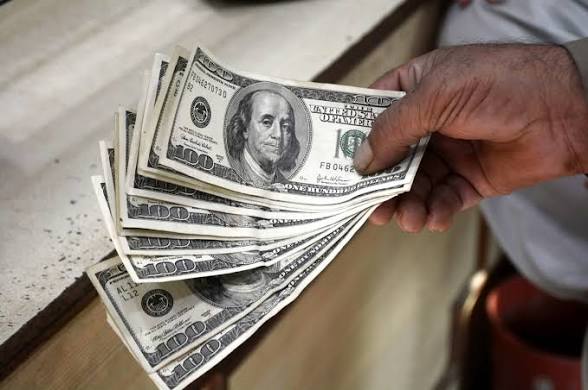
The Nigerian naira opened the first week of May with relative stability across foreign exchange markets, trading at N1,375.98 per dollar on the Nigerian Foreign Exchange Market while the parallel market quoted the greenback between N1,388 and N1,410, according to market data on Sunday, May 4, 2026.
Bureau De Change operators in Lagos and Abuja sold dollars at an average of N1,410, with buying rates around N1,388 to N1,393. The Central Bank of Nigeria’s official rate stood at N1,374.94 per dollar, reflecting a narrowing gap between official and black market windows. “The Nigerian Naira opened the first week of May with a relatively stable performance against the US Dollar across the different segments of the foreign exchange market,” market reports noted.
The pound traded at about N1,720 in the parallel market, while the Canadian dollar exchanged for roughly N1,035. Currency traders said the spread has tightened in recent sessions due to improved dollar liquidity and policy measures aimed at harmonizing the forex market.
On the macroeconomic front, Nigeria’s economy is projected to grow between 4.4 and 4.49 percent in 2026, with inflation expected to ease further. The central bank forecasts 4.49 percent economic growth and inflation easing to an average of 12.94 percent in 2026, citing stable forex markets and rising oil output as reforms take hold. “The growth prospect in 2026 is positive on account of continued gains from broad-based structural reforms and improved stability in the exchange rate,” the central bank said in its 2026 outlook.
The World Bank said Nigeria’s economy is resilient and set to grow in the first half of 2026 despite global shocks, though it warned that rising fuel costs and high inflation risk squeezing incomes. “Overall business activity has been expanding over the past few months, suggesting the impact on growth has been relatively contained. But the shock is still being felt through higher inflation,” World Bank Nigeria lead economist Fiseha Haile said.
Inflation, which eased sharply to 15.06 percent in February from around 33 percent in December 2024, remains elevated compared with regional peers but has continued to moderate. The central bank expects headline inflation, which averaged around 21.26 percent in 2025, to plunge next year as easing food and fuel prices, coupled with forex stability, rein in cost pressures. Inflation slowed for the eighth straight month in November to 14.45 percent.
President Bola Tinubu said Nigeria closed 2025 on a strong note, with annualised GDP growth expected to exceed 4 percent for the year. “We maintained trade surpluses and achieved greater exchange rate stability. Inflation declined steadily and reached below 15 per cent, in line with our target,” Tinubu said in a New Year message. He added that foreign reserves stood at 45.4 billion dollars as of December 29, 2025, providing a buffer against external shocks.
Analysts see further disinflation in 2026. Meristem said the disinflation trend observed in the second half of 2025 is expected to continue into 2026, with inflation projected around 15 percent or lower. FSDH projects GDP growth of 4 percent in 2026, with the naira forecast to remain broadly stable within the N1,520 to N1,590 range, supported by rising reserves and improved market transparency.
Bismarck Rewane, CEO of Financial Derivatives Company, projects GDP growth of about 4.1 percent in 2026, driven by improved productivity, stronger business activity and rising private investment. Central Bank Governor Olayemi Cardoso said GDP grew by 3.98 percent in Q3 2025, the highest for a third quarter in over two years, with ICT, crop production, real estate, and financial services leading the rebound.
Still, risks remain. The World Bank noted that fuel prices have risen more than 50 percent during the Iran war, feeding into transport, food and production costs. It urged Nigeria to consider lifting curbs on fuel imports to help ease inflation. Muda Yusuf of CPPE warned that insecurity, oil price volatility, high energy and logistics costs, and rising debt-service burdens estimated at over 15 trillion naira in the 2026 appropriation could weigh on growth.
For now, traders say the market remains sensitive to global oil prices and domestic monetary policy. The central bank kept its key rate at 27 percent in November’s year-ending meeting but trimmed the deposit rate, signaling confidence in the economy. FSDH anticipates further moderation in the Monetary Policy Rate to between 21 and 24 percent in 2026, conditional on sustained price stability and resilient foreign exchange inflows.
“Despite equity market returns of over 50 percent in 2025, and some stocks exceeding 100 percent, fundamentals still point to significant value, indicating that the market is not overvalued and remains well positioned for further growth,” said Saheed Bashir, managing director of Meristem Stockbrokers.