

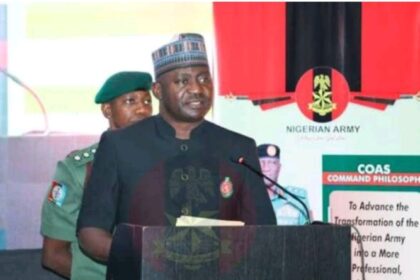
ENPCN Slams Double Speaking Counter-Terrorism Remarks by Defence Minister Musa
The Ethnic Nationalities for Peaceful Co-existence in Nigeria, ENPCN, has expressed deep…

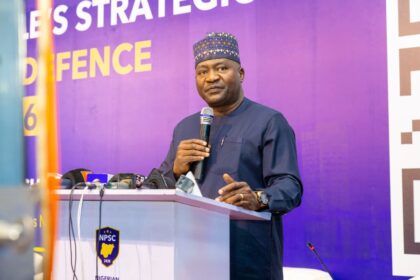
The Magic Wand Has Faded: As Insecurity Deepens, Questions Mount Over Gen. Musa’s Tenure As Minister Of Defence
By Christopher Okoro The appointment of General Christopher Gwabin Musa (Rtd.) as…

Matawalle Receives AANI Zamfara Chapter, Urges Collective Commitment to State Development
The Honourable Minister of State for Defence and former Governor of Zamfara…
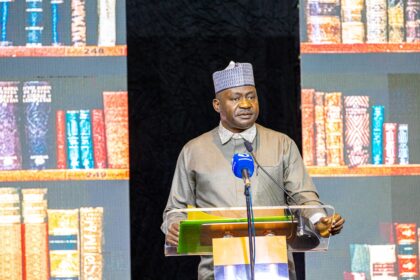
Defence Minister Says Defeating Ignorance Key to Lasting National Security
The Honourable Minister of Defence General Christopher Gwabin Musa (Rtd), OFR has…

Southern Kaduna Confers Grand Commander Title on Defence Minister Christopher Musa
The people of Southern Kaduna have conferred the title of Grand Commander…

Defence Minister Pledges Support to Family of Late Brig. Gen. Oseni Braimah During Abuja Meeting
The Honourable Minister of Defence, General Christopher Gwabin Musa (Rtd), OFR, received…
Nigeria Modernises Defence With AI Powered Drones and Hi Tech Surveillance Systems
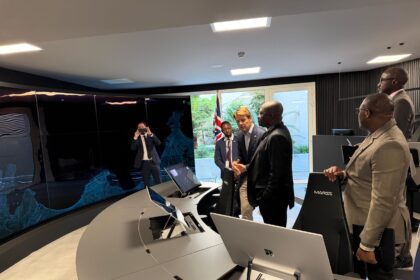
Nigeria is overhauling its defence architecture in 2026 with a sweeping push into ai powered drones, autonomous ground systems and real time surveillance networks aimed at countering banditry, insurgency and cross border threats. The move pairs government agencies, the military and a new wave of local defence tech startups that are now producing indigenous unmanned systems at scale. In Abuja this year, Nigerian startup Terra Industries launched what it describes as Africa’s largest artificial intelligence powered drone production facility, with capacity to manufacture up to 30,000 drones annually for surveillance, infrastructure monitoring and industrial security applications. The company said the plant integrates artificial intelligence into its drone systems to enable real time object detection, automated threat analysis and coordinated monitoring of critical infrastructure such as oil installations, power facilities and mining operations. Terra Industries stated: “Our goal is to build sovereign capability in autonomous aerial intelligence and security infrastructure across Africa”. The firm added that it has begun limited international deployments and plans to expand distribution to additional African markets as demand for autonomous surveillance systems increases. Separately, the Nigerian Defence Industries Corporation partnered with Terra Industries to unveil a new suite of autonomous security technologies in Abuja aimed at supporting military operations. The showcase included interceptor drones, mine detection vehicles and battlefield intelligence software designed to counter evolving insurgent tactics. A company representative said: "We are unveiling new defence systems such as our interceptor UAVs, our minesweepers, ground vehicles that can detect IEDs on the ground, and our battlefield intelligence software". The systems are expected to improve threat detection, surveillance and response efficiency in ongoing counter insurgency efforts across affected regions. The military is also formalising drone use at the command level. In 2026, Nigeria rolled out a powerful Drone Command as part of its new security architecture, deploying advanced ai enabled drones, thermal imaging and real time surveillance to track bandits hiding in forests like Sambisa, Rugu and other criminal corridors. The system integrates real time data, aerial surveillance and precision targeting to track armed groups where they once vanished. At the heart of the system are Nigeria’s drones from imported Bayraktar TB2 unmanned combat air vehicles to rapidly deployed tactical reconnaissance unmanned systems. Thermal imaging technology allows drones to detect heat signatures, bodies, campfires and vehicles hidden under thick canopies in forests like Sambisa and Rugu. Feeds from drones are trained into a centralised command center where ai analytics rapidly process thermal and visual data, identify patterns and queue response units. Analysts and operators work hand in hand to turn raw sensor feeds into actionable intelligence that can be transmitted straight to ground forces across states like Kogi and beyond. The Chief of Army Staff, Waidi Shaibu, announced during Combat Arms Training Week 2026 in Jaji, Kaduna that the Army is increasing investment in unmanned aerial systems to enhance battlefield awareness and strengthen counter terrorism efforts. The Nigerian Army will embed drone warfare and combat aviation into its regular operational and training frameworks, with UAV training institutionalised across all army formations to enhance combat readiness. Beyond the Army, the Defence Space Administration has commenced development of several surveillance and smaller armed drones, including the AYBARS II fixed wing VTOL surveillance drone with 7 to 8 hours endurance and data link range of 100 to 2000 kilometers. Other systems include the ADAN 70 assault drone armed with six 60 mm mortars, the DZK 290 surveillance drone, MIKIYA 20, Oturukpokpo tactical resupply drone and Patroller 20. The agency said satellite imagery, personnel and asset tracking and Unmanned Aerial Vehicle Intelligence Surveillance and Reconnaissance imagery were already procured and have been used to support ongoing counter insurgency operations across the country. The House of Representatives in 2026 declared Nigeria’s borders a national emergency, ordering deployment of drones, satellite imaging and artificial intelligence systems to tackle escalating insecurity. Lawmakers called for long range drones, biometric and ai enabled surveillance, satellite imaging, sensors and reinforced physical barriers. The Nigerian Navy is also adopting the shift. Chief of Naval Staff designate Idi Abbas said the Navy will incorporate more technology, including drones, to tackle maritime crime, noting that using drones will allow monitoring of areas more effectively than fuel heavy patrols. Private sector innovation is driving much of the change. Briech Unmanned Aerial Systems unveiled what it called the first and largest indigenous attack drones and bomb systems in Nigeria and Africa at its Abuja headquarters, with systems configured for high performance reconnaissance and surveillance missions. Features include advanced surveillance and thermal imaging for wide area monitoring, real time intelligence gathering to support on ground tactical operations and rapid response capabilities to intercept or neutralise threats before escalation. The company produces Arginin Reconnaissance Drones, Arsenio BFLY and Xander Reconnaissance drones among other attack drones that can navigate difficult environments. Artificial intelligence is deeply embedded in the drone’s operational framework, with ai driven analytics assisting in target identification, movement pattern analysis and threat prioritisation. Field performance data is being cited to support the expansion. Autonomous drones have detected illegal movements with 92 percent accuracy according to 2023 defense reports and detected 78 percent of hidden insurgent camps during 2024 operations in Sambisa Forest. The systems cut response times by 60 percent compared to manual monitoring in recent Kaduna operations and reduce surveillance expenses by 60 percent compared to traditional helicopter patrols. Machine learning algorithms trained on local terrain data improve detection accuracy by 15 percent compared to traditional surveillance methods. The Ministry of Defence is pursuing a Multi domain Hybrid Intelligence Shield project through strategic engagements with MARSS UK Ltd and its Nigerian partner MPS Mikopowers Ltd. The Minister said the Ministry must increasingly position itself as the strategic brain of Nigeria’s defence architecture by leveraging modern technologies to strengthen intelligence gathering, surveillance capability and operational responsiveness. Technical demonstrations included radar detection systems, ai enabled threat identification platforms, drone interception technologies and the NiDAR integrated command and control system. Defence analysts say the capability and advantages of using ai in planning, operation, surveillance, reconnaissance and targeting are quite enormous. One expert noted that ai can enable decisions in a split second because it can provide the length, size and speed of a ship operating in Nigeria’s waters, or do pattern and terrain analysis to suggest pirate movements. Another added that artificial intelligence may not outsmart human beings in some battle theaters, but those who will win are those at the forefront of developing the ai and integrating it seamlessly with human intelligence. Industry observers say the development reflects growing investment in defence tech innovation on the continent, particularly in ai enabled hardware manufacturing and dual use security technologies. Nigeria’s cutting edge military innovations, including drone surveillance systems, smart armour and border monitoring technologies, are increasingly being developed by private sector firms rather than government agencies. These firms are not just innovating, they are filling urgent capability gaps that traditional procurement channels have struggled to address. …

Defence Minister Pledges Stronger Military Healthcare, Moves to Cut Medical Tourism
The Honourable Minister of Defence, General Christopher Gwabin Musa, rtd, has pledged…

Defence Minister Commends ICRC for Humanitarian Work, Pledges Adherence to Human Rights Protocols
The Honourable Minister of Defence, General Christopher Musa, rtd, has commended the…

United Front for Religious Tolerance Rejects Bribery Claims Against Matawalle, Calls Allegations False and Unfounded
The United Front for Religious Tolerance in Nigeria has firmly rejected allegations…

