

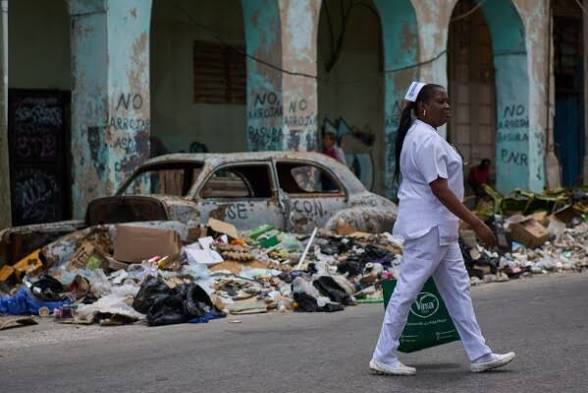
Severe shortages of water, power, and money combined with a U.S. energy blockade have deepened poverty and increased hunger across Cuba, forcing residents from Havana to Santiago to abandon long-established routines as they adapt to increasingly dire realities.
Eduvirgen Zamora, a 56-year-old cafeteria worker in Havana, hides her hands out of embarrassment these days. Her nails are down to the quick, except for her thumbs, which feature inch-long talons covered in fancy silver swirls. Unable to afford a new set of nails as Cuba’s economic crises grind on, she opted instead to do her lashes, a cheaper alternative she hoped would draw people’s attention upward. “The Cuban woman likes to look beautiful — to do her hair, do her nails, do her feet — and wear perfume,” Zamora said. “I don’t look how I would like to look.”
The crisis has forced sweeping changes in beauty routines. Melina Colás, a young manicurist who works in Havana, recently got long braids to celebrate her birthday but quickly realized it’s a difficult style to maintain given chronic water shortages. She used to wear her hair long and straightened but has decided to cut it and wear it natural, even though she thinks it would not suit what she called her short stature and round face. “Before, you could do whatever you wanted,” she said of hairstyles when water was readily available. “Not now.”
Colás has tweaked things at the salon where she works. She has learned patience, aware clients show up late because public transportation is scarce. And she now relies on a mix of water and vinegar in a spray bottle to offset water shortages – a concoction she said also helps soften clients’ cuticles and staves off a growing number of fungus cases because time between manicure appointments is growing longer for many. “Some cases are critical,” Colás said.
Hairstylist Betty Ramírez Aldana, 50, said the island’s economic crisis and shrinking budgets have led to a drop in customers. “It really came as a shock to me, because I’ve lost a lot of clients,” he said on a recent afternoon at a makeshift hair salon with bubblegum pink walls. “Normally by now I’d have five, six, eight clients. Look at the hour. And no one has showed up.” The hair salon where he works recently spent three weeks without water, since electricity powers many pump stations on the island and severe outages are commonplace. He no longer can provide certain hair straightening treatments, so he offers clients options including flattering cuts. “A lot of them have opted to embrace their natural curly hair,” he said.
An increasing number of women also have been forced to grow out their roots given a lack of gasoline and public transportation, coupled with withering budgets, Ramírez said. Those who can afford it call him for home visits, with the original customer likely joined “by her aunt and the upstairs neighbor. I don’t serve one, I serve two or three,” he said.
Beauty aside, Cubans also are agonizing over being forced to cut corners on basic hygiene. Some say they are washing their hair only twice a month, and that clothes stay dirtier longer. Antonia Isalgués Barrién, 60, who works for a state-run company running boats from eastern Havana to the heart of the capital, said she hangs her clothes outside every day after working on a boat because she doesn’t have water to wash them.
The water crisis is tied directly to power. State water utility Aguas de La Habana confirmed that pumping schedules and supply operations have been disrupted by a lack of electricity. “This area is now having water problems. People are hauling water and waiting for the water truck,” said resident Lazaro Noblet, while pushing a small handcart loaded with containers. “Since oil is not coming into the country, there is no pumping, because that system runs on electricity.”
Residents across the Cuban capital hauled buckets and lined up for water from tanker trucks as a combination of fuel shortages and power grid instability left thousands of taps dry. In other districts, Alfonso Pedro Gonzalez checked an empty roof tank before turning a dry faucet. He must boil the small amount of water he manages to collect from trucks.
For many, the struggle is not new. “Our problem has existed since 2021, and now it is 2026,” said 58-year-old Maria de Jesus Rusindo, who has spent years carrying heavy containers into her home.
Transportation has also been upended. Public transportation is scarce, and long lines to buy bread, gasoline, or basic food items have become a regular occurrence. “You have to pay the price or stay at home,” said Daylan Pérez, a young worker from Old Havana. Many transporters have stopped operating due to a lack of fuel, while those that are still in service charge in dollars, a currency that is inaccessible for most people. “Previously, you could buy gasoline with pesos once a month, but now you can’t,” explained a resident.
Power outages also affect those who attempted to adapt with electric vehicles. “I thought I had found the solution, but now I can only charge my taxi four hours a day,” said Alexander Leyet, a Havana driver.
Julia Anita Cobas, a 69-year-old housekeeper from Guanabacoa, gets up at 4 a.m. each morning for a 10-mile commute that now approaches four hours round-trip. With less public transportation available, the journey has become longer and more costly. “I leave my house before sunrise and I don’t know how I’ll get back,” she said.
The Electric Union forecasted widespread blackouts that will simultaneously affect up to 61% of the national territory during peak demand hours. In Havana, unplanned power cuts sometimes top nine hours daily. Many outlying provinces see just two to four hours of electricity a day, vastly reducing productivity and complicating daily life. “The situation with the blackouts is awful, to say the least,” said 18-year-old university student Daniela Castillo. “We arrive home exhausted, there’s no electricity, and many times we have to wait for it to come back on – if it comes back on at all – so that we can eat, so we can study…?”
The energy crunch follows a spike in U.S. pressure on Havana since the January capture of Venezuelan President Nicolas Maduro, Cuba’s primary benefactor. U.S. President Donald Trump has since cut Venezuelan oil shipments to Cuba and threatened tariffs on other suppliers, strangling the island’s fragile power infrastructure.
Cuba’s government blames the fuel shortages, decrepit infrastructure and damage from Hurricane Melissa for worsening power outages, which are increasingly hitting the capital Havana. Almost 900 megawatts of power generation, nearly a third of daily demand, was shut down on Wednesday due to lack of fuel and lubricants, the country’s electrical union said.
The UN has warned of growing humanitarian risks. With five million people living with chronic illnesses, treatments are at risk due to the current energy crisis. Nearly one million people get their drinking water from tanker trucks, while 84 per cent of pumping equipment depends on electricity. Food security is also deteriorating with disruptions affecting the whole supply chain.
Even those who are more affluent are now eliminating long-established and often beloved routines as they adapt to increasingly dire realities. The situation has forced Cubans to reorganize daily life around securing food, water, and electricity, with domestic routines now planned to take advantage of any opportunity to cook, preserve food, or store water when electricity or fuel is available.