

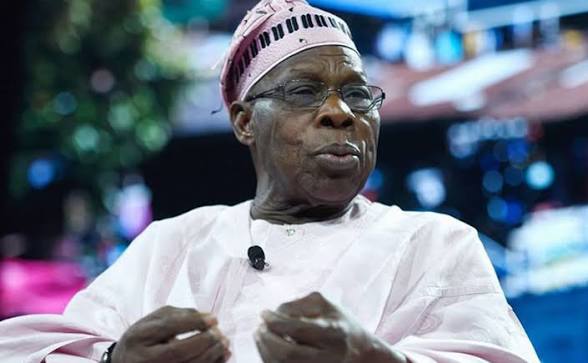
Former President Olusegun Obasanjo has reiterated that Nigeria’s four oil refineries will never work as long as the government continues to hold onto them, blaming entrenched corruption and years of mismanagement for the facilities’ persistent failure.
Speaking in an interview with TheCable, Obasanjo said the refineries in Warri, Port Harcourt and Kaduna will not function under state control. “They will not work as long as the government is keeping hold of them,” he said. “When I was president, I invited Shell to a meeting. I told them I wanted to hand over the refineries for them to help us run. They bluntly told me they would not. I was shocked.”
Obasanjo disclosed that after much persuasion, the managing director of Shell at the time listed four reasons why the oil company would not get involved in running Nigeria’s refineries. “I repeated the request and they stood their ground. When the meeting was over, I asked their big man (MD) to wait behind for a little chat. Then I asked him why they were so hesitant on not taking over the refineries. He said did I want to hear the truth? I said yes. He listed four reasons. One, he said Shell makes its money from upstream and that is where its interest lies. Two, he said they only do downstream or retail as a matter of service. Three, he said our refineries would be bad business for them, that globally, companies are going for bigger refineries because of the economics of refineries. Four, he said there is too much corruption in refineries,” Obasanjo recounted.
He revealed that after Shell’s refusal, Africa’s richest man, Aliko Dangote, assembled a team and paid $750 million to operate the refineries through a public-private partnership. “Aliko got a team together and they paid $750m to take part in PPP in running the refineries. My successor refunded their money and I went to my successor, I told him what transpired, he said NNPC said they wanted the refinery and they could run it and I said but you know they cannot run it,” Obasanjo stated.
The former president said more than $2 billion has been squandered on the refineries since then, yet they still do not work. “I was told not too long ago that since that time, more than two billion dollars have been squandered on the refinery and they still will not work,” he said. “If a company like Shell tells me what they told me, I will believe them. If anybody tells you now that it is working, why are they now with Aliko? And Aliko will make his own refinery work; not only make it work, he will make it deliver.”
Obasanjo maintained that the Nigerian National Petroleum Company cannot run the facilities. “I told my successor that ‘the refineries, from what I heard and know, will not work and when you want to sell them, you will not get anybody to buy them at $200m as scrap’. And that is the situation we are in,” he said. “So, why do we do this kind of thing to ourselves? NNPC knew that they could not do it, but they knew they could eat and carry on with the corruption that was going on in NNPC. When people were there to do it, they put pressure. In a civilised society, those people should be in jail.”
He likened inflated claims about the refineries’ performance to a Yoruba proverb. “They say after he has harvested 100 heaps of yam, he will also have 100 heaps of lies. You know what that means,” Obasanjo said.
The former president’s comments come despite recent announcements by the Nigerian National Petroleum Company Limited that the Port Harcourt and Warri refineries had resumed operations in late 2024. NNPC had said Port Harcourt was operating at 70 per cent functionality, while Warri was at 60 per cent. Obasanjo, however, expressed doubt over the workability of the facilities. “So if anybody tells you now that they are working, why are they not with Aliko? And Aliko will make his own refinery work. Not only make it work, he will make it deliver,” he said.
He noted that President Bola Tinubu had assured in August 2023 that the petroleum refinery in Port Harcourt would start working by December 2023. Obasanjo said government-owned refineries will never be functional under state management. “They will not work as long as the government is keeping hold of them,” he insisted.