

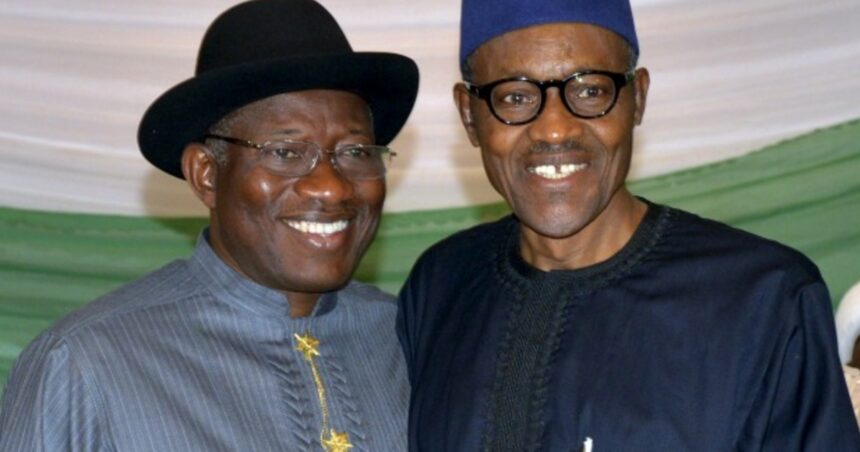
Goodluck Jonathan, Nigeria’s former president, has revealed that Boko Haram once selected Muhammadu Buhari as their representative for peace negotiations with the federal government, sparking his expectation that Buhari would swiftly resolve the insurgency upon becoming president. Speaking at the launch of General Lucky Irabor’s book “Scars” in Abuja, Jonathan expressed bewilderment over the group’s continued activities despite this nomination.
“Boko Haram nominated Buhari to lead their team to negotiate with the government. So I was feeling that, oh, if they nominated Buhari to represent them… when Buhari took over, it could have been an easy way to negotiate with them and they would have handed over their guns. But it was still there till today,” Jonathan stated, highlighting his surprise at the insurgency’s endurance.
Jonathan, who led Nigeria from 2010-2015 amid intense Boko Haram attacks, stressed the complexity of the crisis transcends common narratives. “The issue of Boko Haram is far more complex than it is often presented… If you conduct research and interview many people, you will only get part of the story, but never the full story of Boko Haram,” he said, underscoring the multifaceted nature of the threat.
Recalling the 2014 Chibok schoolgirls abduction, Jonathan called it “a permanent scar” he’ll carry lifelong. “It is a scar I will die with,” he remarked, expressing hope that clearer insights might emerge over time, perhaps through accounts by Boko Haram leaders themselves. “I pray that one day, some of the Boko Haram leaders may be literate enough to document what they have done, so that people will truly understand what they wanted.”
Jonathan advocated for a shift in strategy, pointing to external backing suggested by the insurgents’ advanced weaponry. “If you look at the weapons they use… these are not hungry people… Where are these guns, sophisticated weapons coming from?… The external hands are also involved,” he noted, calling for consideration of “carrots and the stick” approaches beyond simplistic explanations like poverty-driven motives.
The former president lauded General Irabor’s documentation efforts, valuing recorded histories to contextualize Nigeria’s security challenges. “I always appreciate people who document events clearly. That way, when we write our own accounts, we can borrow from such documentation,” Jonathan said.