

Washington – In a strongly worded statement released on Wednesday, the U.S. State Department announced a new visa restriction policy aimed at anyone who has directed, authorised, supported, participated in, or carried out religiously motivated abuses against Christians in Nigeria. The measure, enacted under Section 212(a)(3)(C) of the U.S. Immigration and Nationality Act, also allows the denial of visas to immediate family members of those sanctioned.
“As President Trump has made clear, the United States will not remain silent while such atrocities occur in Nigeria and other affected countries,” the statement read. Officials stressed that the policy is not limited to Nigeria; it applies to any government or individual worldwide involved in violations of religious freedom.
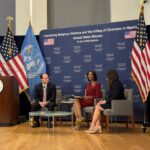
The announcement comes as the United States and Nigeria hold talks on the escalating wave of violence by extremist groups across the country. Earlier this year, U.S. officials accused the Nigerian government of failing to curb anti‑Christian attacks—a claim Abuja firmly rejected. In response to the growing crisis, President Donald Trump had previously designated Nigeria a “Country of Particular Concern” (CPC) and even hinted at the possibility of deploying U.S. troops if the insecurity persisted.
Secretary of State Marco Rubio, who earlier vowed visa bans over the “Christian genocide” in Nigeria, reiterated that the new rule is a decisive step to hold perpetrators accountable. “We will restrict visas for those who have directed, authorized, significantly supported, participated in or carried out violations of religious freedom,” Rubio said, emphasizing that the policy will affect both Nigerian officials and any other actors responsible for such abuses.
The State Department’s notice warned that immediate family members of sanctioned individuals may also be denied entry, underscoring the broad reach of the measure. As the U.S. continues to press for greater protection of religious minorities, the policy signals a heightened willingness to use immigration tools to enforce international religious‑freedom standards.
The development adds a new layer to the already tense diplomatic dialogue between Washington and Abuja, where discussions about security cooperation and human‑rights concerns are now intertwined with the threat of visa restrictions and potential further sanctions.