


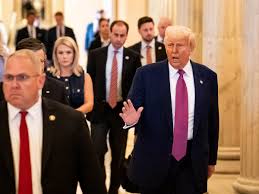
Washington, D.C. — The atmosphere on Capitol Hill intensified as members of the United States Senate publicly urged President Donald J. Trump to consider stepping down, placing him back under an intense national spotlight. A cluster of congressional actions invoking some of the Constitution’s most severe accountability mechanisms has heightened scrutiny of the president, underscoring a widening rift between the executive branch and segments of the legislative branch.
In recent days, lawmakers have introduced or advanced resolutions that cite the 14th Amendment’s disqualification clause, pursue formal censure, and call attention to the 25th Amendment’s provisions regarding presidential capacity. While none of the measures currently carries the votes required to remove the president from office, their simultaneous emergence reflects an unusual convergence of institutional pressure.
At the center of the debate is Section 3 of the 14th Amendment, the so‑called insurrection clause adopted after the Civil War to bar individuals who, after swearing an oath to support the Constitution, engage in rebellion from holding federal office. A Senate resolution introduced this session expresses the chamber’s view that Mr. Trump’s conduct surrounding the events of January 6, 2021, warrants scrutiny under that provision. Constitutional scholars have long debated whether Section 3 is self‑executing or requires congressional enforcement. Recent court rulings, including from the Supreme Court, have addressed related ballot‑eligibility questions, shaping but not fully settling the broader constitutional landscape. The current resolution, however, is nonbinding, representing the “sense of the Senate” rather than a direct legal disqualification.
Separately, members of the House have introduced a censure resolution formally condemning the president’s conduct. Censure does not remove a president from office or impose legal penalties; it serves as an institutional rebuke, a formal expression of congressional disapproval placed into the historical record. Supporters argue that documented statements and executive actions have undermined democratic norms and judicial independence. Opponents characterize the resolution as politically motivated and warn against normalizing escalating partisan conflict.
In addition, some senators have publicly raised the prospect of invoking the 25th Amendment, which provides a process for declaring a president unable to discharge the powers and duties of the office. Section 4 requires the vice president and a majority of the Cabinet to initiate the process, followed by potential congressional review. Historically, it has been understood primarily as a safeguard against medical incapacity rather than a tool for resolving political disputes. There is no indication that the vice president or Cabinet members are preparing to take such action, but the public discussion signals the depth of concern among certain lawmakers.
Political analysts note that the simultaneous pursuit of multiple constitutional pathways—disqualification, censure, and capacity review—is rare. “It is unusual to see these mechanisms discussed in parallel,” said one constitutional law professor. “Each was designed for extraordinary circumstances.”
At present, practical barriers to removal remain high. Impeachment would require a majority vote in the House and a two‑thirds vote in the Senate for conviction. Disqualification under the 14th Amendment would likely require judicial adjudication. The 25th Amendment demands executive‑branch participation that appears unlikely. Nonetheless, the introduction of these measures contributes to a formal institutional record. Congressional resolutions, even when symbolic, articulate findings and interpretations that may shape future legal and historical assessments. Lawmakers backing the efforts say documentation matters, that establishing a clear legislative position is part of Congress’s constitutional responsibility.
White House officials have dismissed the initiatives as partisan maneuvers lacking sufficient support. They emphasize that the president was duly elected and continues to exercise the full powers of the office. For now, the immediate balance of power remains unchanged. The president retains executive authority, and none of the measures has advanced to a decisive vote capable of altering that reality.
The episode highlights a period of heightened constitutional tension, with lawmakers reaching for provisions historically reserved for moments of profound institutional strain. Whether these efforts gain momentum or recede will depend on political calculations, legal interpretations, and public response in the weeks ahead. What is clear is that the debate unfolding on Capitol Hill is less about a single vote than about the boundaries of presidential power and the tools Congress is willing to consider when it believes those boundaries have been tested.