

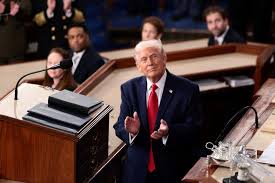
Washington, D.C. – Donald Trump delivered the longest State of the Union address in American history on Tuesday night, speaking for a record one hour and 47 minutes before a closely watching United States Congress. In his marathon speech, Trump declared what he described as a “golden age of America,” highlighting his administration’s economic record as proof of national resurgence. He pointed to gains in the stock market, progress on inflation, significant tax cuts, and lower prescription drug prices as evidence of his administration’s successes.
The president claimed that the stock market had achieved 53 record highs since his second-term victory, asserting that Americans’ retirement savings had grown substantially. He also unveiled a proposal for the federal government to match up to $1,000 in 401(k) contributions for certain workers who currently lack employer-sponsored retirement plans, though he offered limited details on the initiative’s implementation.
The address unfolded amidst political headwinds. Public opinion surveys have reflected widespread frustration over rising living costs, and Trump’s signature tariff agenda recently suffered a setback after the U.S. Supreme Court struck down much of his import tax framework. Despite ongoing market uncertainty, Trump offered little new information regarding the future direction of his global trade policy.
Foreign policy received comparatively brief attention during the lengthy address. Although his administration has overseen an expanded military presence in the Middle East, Trump did not mention Iran until more than an hour into the speech, reiterating that Tehran “must never acquire a nuclear weapon.” References to Russia and Ukraine were limited, and Venezuela was mentioned only briefly.
On the critical issue of immigration, Trump renewed his assertions that undocumented migrants are contributing to violent crime, claims that numerous studies have disputed. During this portion of the speech, Democratic Representative Ilhan Omar interrupted from the chamber floor, shouting, “You have killed Americans!”
The evening featured other moments of protest. Representative Al Green, who was removed during a Trump address for the second consecutive year, later stated he had brought a sign reading “BLACK PEOPLE AREN’T APES!” to condemn a social media post that had shared and later deleted imagery depicting former President Barack Obama and former First Lady Michelle Obama as apes.
Delivering the Democratic response, Virginia Governor Abigail Spanberger painted a sharply contrasting picture of the nation’s economic outlook. She argued that American families remain heavily burdened by tariffs and high consumer prices, accusing the administration of prioritizing corporate interests over working households. Labor leaders echoed this criticism, with Liz Shuler, president of the AFL-CIO, dismissing the address as a “fever dream,” contending that it failed to adequately address the economic pressures confronting workers.
Throughout his speech, Trump made direct political appeals, labeling Democrats “crazy” for opposing his legislative agenda and accusing them of seeking to “cheat” in elections – a reference to Republican-backed proposals requiring proof of citizenship for federal voting. Despite the charged atmosphere, the president largely adhered to his prepared remarks, even shaking hands with Supreme Court justices days after publicly criticizing the court’s recent tariff ruling.
By the conclusion of the night, Trump had surpassed his own previous record for the longest presidential address to Congress. Supporters described the performance as a confident defense of his agenda, while critics argued it offered more rhetoric than concrete solutions to the day-to-day concerns of voters.