

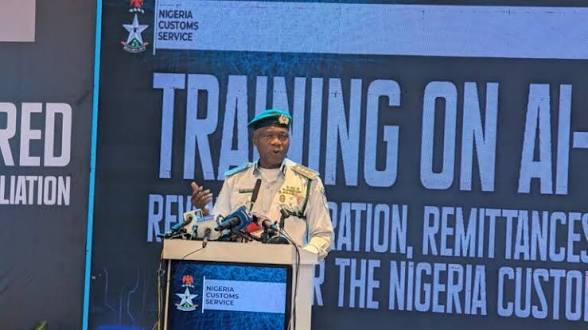
ABUJA – The Nigeria Customs Service is moving to boost revenue transparency and efficiency with a new Artificial Intelligence training program that has upskilled more than 1,800 officers in advanced data analytics, risk profiling, and AI, as part of a wider shift to intelligence-led operations and the $3.2 billion E-Customs Modernisation Project.
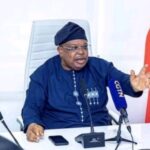
Comptroller-General of Customs, Bashir Adewale Adeniyi, said the Service is no longer focused on physical inspection alone and is retraining personnel to match global standards. “Customs is no longer just about physical inspection. We are becoming an intelligence-led organisation, and our officers are being retrained to match global standards,” Adeniyi said. He added that over 1,800 officers have received advanced training in data analytics, artificial intelligence, and risk profiling to align with the agency’s shift toward intelligence-led operations.
The AI training is a key component of the E-Customs Modernisation Project, a 20-year, $3.2 billion initiative that aims to overhaul cargo processing, surveillance, and payment systems across ports and borders. The project is projected to generate $250 billion in cumulative revenue over two decades by plugging systemic leakages and unlocking new revenue streams. “When fully deployed, the digital system is expected to unlock vast new revenue streams and plug systemic leakages that have historically drained the nation’s finances,” Adeniyi said.
The digital push is already showing results. The Service recorded N1.3 trillion in revenue in the first quarter of 2025 alone, more than double the N600 billion collected during the same period in 2023. “This is not due to an increase in import volumes. Imports have actually declined due to forex constraints. What has changed is efficiency, transparency, and enforcement,” the CG said.
Adeniyi said the technology drive supports President Bola Tinubu’s directive to the Service. “The President gave us a clear directive: block leakages, facilitate trade, and raise revenue without burdening Nigerians. That is what we are doing. And the results are beginning to speak for themselves,” he said. He credited improved coordination with security agencies and the use of surveillance drones and data-driven strategies for the progress, stating, “We’re no longer reacting blindly. We’re using technology and intelligence to intercept violations in real-time”.
At the Nigerian Institute of Journalism’s 7th convocation, Adeniyi advocated for the strategic application of AI in public governance, saying the technology holds immense potential to combat corruption, enhance transparency, and drive efficiency in service delivery. He urged young journalists to understand how algorithms work and to critically evaluate them to ask the right questions.
Other digital reforms are running in parallel. The Unified Customs Management System, also known as B’Odogwu, has facilitated N230 billion in revenue at the Ports & Terminal Multiservices Limited Command since October 2024. PTML Area Controller Tenny Daniyan described B’Odogwu as “a more robust and more secure platform with some AI features that can help do a proper classification of things”. The Service has also launched the Excise Register System to automate excise registration, payment of duties, and statutory reports, aimed at reducing manual documentation and enhancing transparency.
Clearance timelines at key ports like Apapa and Tin Can have already been reduced from 21 days to 7–10 days for compliant traders under the push for a National Single Window platform. Exports of solid minerals and agricultural products rose by 38% in 2024, reaching over N340 billion, with more growth expected this year.
The NCS has set an ambitious N9 trillion revenue target for 2026, banking on automation of licenses and permits to reduce human interface and processing time. “The flag off of the automation of licenses and permits is a direct response to the long-standing need to make NCS processes faster, more transparent, and easier for the people they serve,” Adeniyi said, represented by ACG Muhammad Babandede at a Lagos sensitisation event.
“The capacity to learn is a gift, the ability to learn is a skill, but the willingness to learn is a choice. The Nigeria Customs Service has chosen to make PCA work in our country,” DCG Kikelomo Adeola said at a World Customs Organisation Accelerated Trade Facilitation Programme with the World Bank.