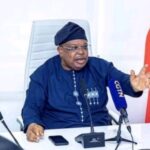


The Movement for Credible Elections has called for the immediate stepping aside of the Chairman of the Independent National Electoral Commission, Professor Joash Ojo Amupitan, citing a deepening credibility crisis and allegations of partisan association ahead of the 2027 general elections.
The demand was contained in a press statement issued on Sunday, 19th April, 2026, and signed by its Media Coordinator, Comrade James Ezema. The organisation said it was “compelled, in the overriding public interest, particularly in defense of Nigeria’s electoral integrity, to issue this statement as touching the deepening crisis of confidence surrounding the office of the Chairman of the Independent National Electoral Commission (INEC).”
The group warned that Nigeria’s democratic process was facing a dangerous test of legitimacy. “At this crucial period in Nigeria’s democratic evolution, it is evident that the hands presiding over INEC are, at best, under grave distrust and, at worst, compromised to elicit the credibility required for the conduct of the 2027 elections,” Ezema said.
At the centre of the controversy are alleged digital traces and online expressions purportedly linked to the INEC Chairman, which critics claim show political sympathy toward the ruling All Progressives Congress. Although Professor Amupitan has denied the allegations, the MCE argued that such denials do not settle the matter in a digitally traceable environment.
“While Professor Amupitan has issued categorical denials, such denials—within the context of modern digital forensics—do not extinguish suspicion; rather, they activate a higher threshold for verification,” the statement read. It further stressed that “in this digital age, denial is not a defence—it is an invitation to forensic scrutiny.”
According to the group, the matter has already moved beyond political speculation into what it described as a potential forensic and legal crisis. It argued that “the public domain is already saturated with analytical trails allegedly connecting the disputed account to identifiable personal and financial markers,” including systems governed by strict identity verification frameworks.
Raising further concerns, the MCE warned that “banking and identity verification systems, particularly those governed by BVN and NIN protocols, provide traceable ownership structures that are legally discoverable under subpoena,” while also noting that “digital platform operators maintain device-level access logs, including IMEI-linked login histories, which are admissible in judicial proceedings.”
The organisation cautioned that escalation of the matter could lead to serious legal consequences. “Any escalation of this matter into sworn testimony raises the spectre of legal crisis bordering on perjury, with severe professional and constitutional consequences,” Ezema said.
It also accused those managing the controversy of potentially mischaracterising legitimate inquiry. “The attempt to reframe legitimate public inquiry as cybercrime—accompanied by threats of arrest—constitutes a dangerous misuse of state apparatus,” the statement read.
Beyond the immediate allegations, the MCE raised broader concerns about INEC’s institutional neutrality, warning of what it described as a pattern of conduct capable of undermining opposition participation in elections. It said it was “alarmed by a growing pattern of actions and decisions by INEC that have been widely interpreted as detrimental to opposition political participation in Nigeria,” citing “administrative inconsistencies, selective enforcement of electoral regulations, and operational conduct.”
The group warned that the cumulative effect of such developments could be far-reaching. “The aggregation of these concerns lends credence to a disturbing hypothesis: that Nigeria is being subtly but systematically steered toward a de facto one-party and one man rule in violation of both the letter and spirit of Nigeria’s constitutional democracy,” Ezema said.
On the international dimension, the MCE said the controversy could expose Nigeria to reputational and legal risks beyond its borders. It cautioned that “should aggrieved parties seek redress before regional judicial bodies, including the ECOWAS Court, the Nigerian State may face international embarrassment, adverse rulings, and financial liabilities,” adding that this could affect Nigeria’s global democratic standing.
The statement also raised ethical concerns regarding the INEC Chairman’s fitness for office, referencing what it called “exhumed digital expressions of AMUPITAN—widely interpreted as supportive of the APC during the last electoral cycle,” which it said “raise fundamental ethical questions.” It warned that if validated, such claims would amount to “prima facie evidence of pre-existing partisan alignment inconsistent with the neutrality required of an electoral umpire.”
The MCE further suggested that such developments could point to deeper structural issues. “The appointment of Professor Amupitan may have been influenced by partisan considerations, thereby undermining the moral foundation of his office and the 2027 elections,” the statement read.
In its formal demands, the organisation called for immediate institutional action. It insisted “that Professor Joash Ojo Amupitan immediately step aside from his position as Chairman of INEC to allow for a truly independent, transparent, and forensic investigation into the allegations,” and urged the Federal Government “to constitute an impartial panel comprising judicial, digital forensic, and civil society experts to ascertain the truth.”
It also demanded an end to intimidation of citizens raising concerns. “That all forms of intimidation, harassment, or threats against citizens raising legitimate concerns be halted forthwith,” the statement said, and called on INEC to “recommit itself to institutional neutrality through verifiable reforms that restore public confidence.”
Concluding its statement with a stark warning about Nigeria’s democratic future, the MCE declared that “Nigeria stands at a democratic crossroads,” stressing that “the integrity of its electoral management body cannot be compromised without grave consequences for credible elections, national stability and legitimacy of governance.”
It further stated that the issue was no longer personal, but national in scope. “Professor Amupitan must recognize that this is no longer a personal matter of denial—it is a national question of trust,” Ezema said, adding that “the only honourable path, consistent with both legal prudence and moral responsibility, is to step aside and submit to the cleansing light of transparent investigation.”
The group ended with a cautionary reflection on historical accountability. “History will not be kind to those who, when confronted with questions of integrity, chose concealment over accountability,” the statement read.