


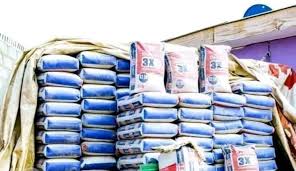
The Federal Government has banned the importation of bagged cement and released an updated list of restricted goods, as part of efforts to protect local industries and stabilise the economy.
The move comes as the Ministry of Housing and Urban Development warned cement manufacturers that the government may open the borders to enable cement importation if local producers refuse to reduce prices. Minister Ahmed Dangiwa said key input materials for cement production such as limestone, clay, silica sand, and gypsum are sourced within the nation’s borders and should not be dollar-rated. “The border was closed to the importation of cement to help local manufacturers,” Dangiwa said. “However, he noted that if the government decides to open the border for mass importation, prices of cement would crash and local manufacturers would be gravely affected.”
The government and major manufacturers have meanwhile agreed on a price range for the commodity. “The three cement manufacturers: Dangote Cement Plc, BUA Cement Plc and Larfarge Africa Plc have agreed that cement cost will not be more than between ₦7,000.00 and ₦8,000.00/50kg bag depending on the location,” the Ministry said. “Government expects the agreed price to drop after securing government’s interventions on the challenges of the manufacturers on gas, import duty, smuggling, and better road network.”
Despite the earlier threat to permit imports to force prices down, bagged cement remains on the prohibited list under HS Code 2523.29.00.00, according to the Nigeria Customs Service update on restricted goods. “Bagged cement remains prohibited,” the update stated, alongside NPK 15:15:15 fertilisers and related products. The policy also extends to packaging materials, corrugated paper and cartons, as well as certain glass bottles and wide corrugated sheets.
The full list of restricted items covers a broad range of consumer and industrial goods. In the consumer goods segment, the government has sustained prohibitions on items such as packaged sugar and flavoured sucrose. Cocoa derivatives, including cocoa butter, powder, and cakes, as well as chocolate in bulk blocks exceeding two kilograms, are equally restricted. Household staples like tomato paste, retail-packaged tomatoes, and bottled mineral or aerated water are now limited to domestic production.
The hygiene sector faces tighter controls, with soaps and detergents for retail sale barred under HS Codes 3401.11.10.00 to 3402.90.00.00. “All forms of soaps and detergents meant for retail sale are now barred from importation,” the update read. “This is expected to boost local manufacturers, although it may raise concerns about supply and pricing in the short term.”
Even everyday stationery is affected, as ballpoint pens and their refills are barred from importation, though the government made a specific concession for importing pen tips. “Even simple items like ballpoint pens and their refills have been included in the prohibition list, though pen tips are still allowed for importation,” the update noted. “This suggests a push to encourage local assembly and production.”
In the industrial space, restrictions also continue on packaging materials, corrugated paper, paper boards, and cartons. The glass industry is protected by a prohibition on hollow glass bottles exceeding 150 milliliters in capacity. Flat-rolled products of iron or non-alloy steel, specifically corrugated sheets wider than 600 millimeters, are also restricted.
The government has also banned the importation of several essential drugs, including paracetamol, aspirin, and other medicines, to encourage local pharmaceutical production. “The policy is already generating reactions from stakeholders, especially in the health sector, where concerns are growing over whether local manufacturers can meet the nation’s demand for essential medicines,” a report said.
In the food segment, refined vegetable oils packaged in small retail sizes have been prohibited, while crude vegetable oils and certain industrial fats are still allowed for manufacturing purposes. “The ban also affects several everyday consumer goods. Items such as sugar in retail packs, tomato paste, and bottled water are now restricted,” the update read.
The Nigeria Customs Service is set to enforce the updated regulations. “With the Nigeria Customs Service set to begin full enforcement, importers and businesses are expected to adjust quickly. Failure to comply could lead to seizure of goods and possible legal action,” the update warned. Businesses across all sectors must align their procurement strategies with this legal framework to avoid the seizure of goods and legal penalties.
The latest policy reverses an earlier Central Bank of Nigeria decision that lifted foreign exchange restrictions on 43 items, including cement, rice, and toothpicks. The former CBN Governor, Godwin Emefiele, had placed restriction on access to the official foreign exchange market for the importation of some 43 items before the removal by government of President Bola Ahmed Tinubu. However, the current trade policy restores bans on several of those items, with cement among the goods now prohibited for importation.
The U.S. Trade Representative has criticised Nigeria’s import ban on 25 product categories, saying it limits market access for American exporters. In a post on X, the USTR described the policy as an unfair trade practice affecting key sectors such as agriculture, pharmaceuticals, beverages, and consumer goods. Among the banned products listed by the USTR are live or frozen poultry, pork, beef, spaghetti, fruit juices in retail packs, sugar, vegetable oil, soaps, beer, sanitary plastics, tyres, and cement.