


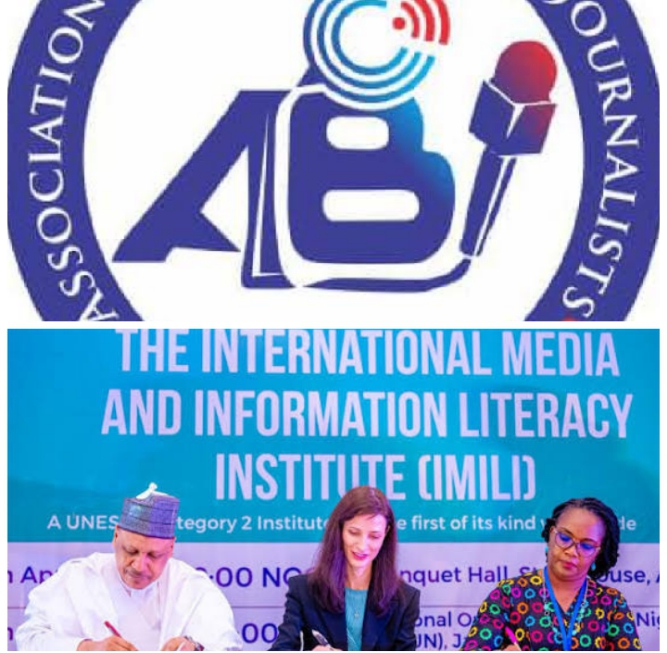
The Association of Bloggers and Journalists Against Fake News has urged the Nigerian government to move quickly on policy reforms following the country’s selection as host of a pioneering global media institute, calling it a watershed moment for information governance.
In a press release issued Tuesday in Abuja, ABJFN National President Comrade James Ezema described the creation of the International Media and Information Literacy Institute under UNESCO as “a defining moment in Nigeria’s evolving information governance landscape.” He said the decision reflects “a strong global endorsement of the country’s potential to lead in advancing media literacy, digital responsibility, and information integrity,” positioning Nigeria at the center of international efforts to counter misinformation and disinformation.

The group stressed that the milestone should not be treated as symbolic. “This milestone must extend beyond symbolism and translate into measurable, citizen-centered outcomes that strengthen democratic processes, media credibility, and public trust,” the statement said.
ABJFN noted that hosting the world’s first institute of its kind gives Nigeria “a strategic opportunity to reposition the country as a hub for knowledge-driven solutions to the growing global challenge of misinformation and disinformation.” It is now pushing for an immediate rollout of a comprehensive National Information Integrity Framework built on Media and Information Literacy principles. According to the association, such a framework would “provide a coordinated national response to the proliferation of misinformation” and help citizens develop “critical thinking skills required to navigate an increasingly complex digital information environment.”
The association highlighted that in today’s digital landscape “every citizen functions as both a consumer and distributor of information,” and warned that “safeguarding the integrity of the information space must be treated as a shared national responsibility.” It called for joint action among “government institutions, media organizations, civil society actors, and the general public” to foster “a resilient and trustworthy information ecosystem.”
Among its proposals, ABJFN recommended embedding Media and Information Literacy across all levels of Nigeria’s education system and launching sustained public awareness drives on responsible digital use. It also suggested “collaborative mechanisms between IMILI and civil society organizations to ensure effective grassroots impact,” along with “ethical standards and certification systems for bloggers and digital publishers” and greater openness in government communications.
The group warned that the threat posed by fake news has escalated. “Fake news is no longer a peripheral media concern but a critical threat to national security, electoral integrity, and social cohesion,” the statement said.
ABJFN reaffirmed its readiness to work with stakeholders including IMILI on public education, training, and policy advocacy to bolster Nigeria’s information environment. Concluding, it said Nigeria must match its new international role with domestic progress: “Nigeria cannot host a global institute dedicated to information integrity while tolerating systemic misinformation within its domestic environment,” adding that “this moment demands collective responsibility, institutional commitment, and sustained action.”