

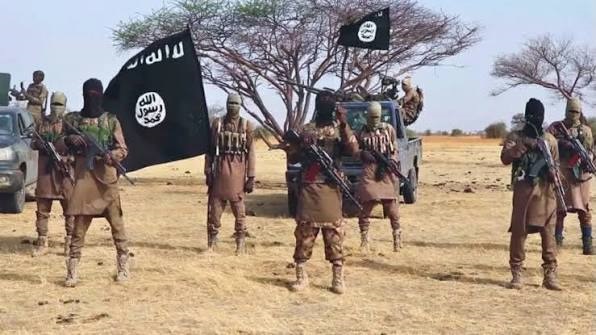
A Lagos-based Nigerian businessman, Muhammad Mukhtar Adamu, has been sanctioned by the United States government over his alleged role in financing the terrorist group Islamic State West Africa Province (ISWAP).
The sanctions, announced on Monday by the U.S. Department of the Treasury’s Office of Foreign Assets Control (OFAC), form part of a broader crackdown targeting individuals and businesses accused of facilitating financial transactions for the Islamic State (ISIS) across Europe, the Middle East and West Africa.
According to U.S. authorities, Adamu allegedly used a network of currency exchange businesses to move funds on behalf of ISIS-West Africa, helping the terrorist organisation sustain its operations and support affiliated groups.
The Treasury Department identified Adamu, a resident of Agege, Lagos, as a key figure in the financial network. He was listed as a Specially Designated Global Terrorist (SDGT), alongside French national Abderrahmane Miloud and Syrian national Abdelhakim Boukich.
U.S. officials said the sanctions are aimed at disrupting a transnational financing structure stretching from France and Syria to Türkiye and Nigeria, which allegedly enabled ISIS to transfer money, support attacks and maintain its global operations.
Three Nigerian companies linked to Adamu were also sanctioned. They include General Currency Bureau De Change Limited, incorporated in Lagos in January 2019; Manhattan Bureau De Change, based on Murtala Mohammed Way in Kano and incorporated in January 2021; and Nine To Nine Exchange Bureau De Change, located within the FAAN Complex on Airport Road, Lagos, and incorporated in August 2017.
While Adamu is accused of facilitating funds for ISIS-West Africa, Boukich allegedly used cryptocurrency platforms to transfer money on behalf of ISIS associates, while Miloud is accused of providing explosives-related information to ISIS supporters.
The U.S. State Department said the sanctions reflect ongoing efforts to cripple the terrorist group’s financing channels and weaken its operational capabilities.
“We will continue to use every diplomatic and legal tool available to hold ISIS and its supporters accountable—wherever they operate and however they move money,” the department said in a statement.
The U.S. government also highlighted its security cooperation with Nigeria, noting that both countries jointly carried out the May 16, 2026 operation that killed Abu-Bilal al-Minuki, described as ISIS’s second-in-command.
According to U.S. officials, sustained military and intelligence pressure has forced ISIS to increasingly rely on financial intermediaries and covert networks to sustain its activities, making the disruption of such channels a key counterterrorism priority.