

The Nigerian Naira started the trading week with minor adjustments across foreign exchange markets, showing resilience despite persistent demand for the United States Dollar, according to market data for Monday, April 20, 2026, through Tuesday, April 21, 2026.
In the Nigerian Foreign Exchange Market, which serves as the official trading window, the Naira was quoted at an average rate of 1347.33 per Dollar during early morning sessions on Monday, April 20, 2026. This represents a minor depreciation from the closing figures observed at the end of last week. Market participants noted that while liquidity remains relatively stable due to consistent Central Bank monitoring, the opening hours saw a slight uptick in demand that pushed the rate marginally higher from the previous Friday’s levels.
By Tuesday, April 21, 2026, the Central Bank of Nigeria set the US Dollar to Naira exchange rate at ₦1,350.7402, compared with ₦1,349.6737 at the beginning of the week on Monday. This corresponds to a 0.08% rise for USD in CBN rates this week. When compared with the start of April, when the USD rate was ₦1,378.7011 on Wednesday, April 01, 2026, the data shows a 2.03% decrease for US Dollar to Naira exchange rates in CBN for this April.
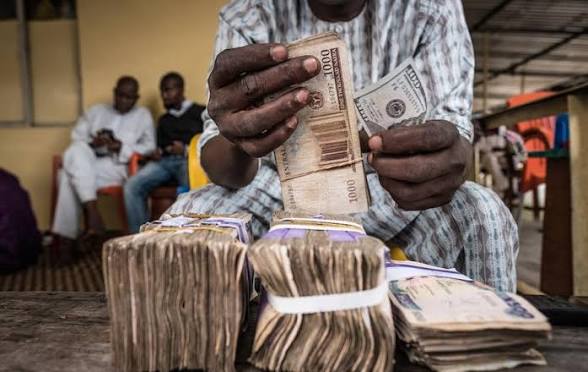
The parallel market, often referred to as the black market, continues to trade at a premium. On Monday, Bureau De Change operators reported buying rates around 1395 and selling rates near 1405 per Dollar in major urban hubs such as Lagos, Kano, and Abuja. More recent reports indicate the Naira weakened to N1,478 per US Dollar in the parallel market, shifting from its previous rate of N1,475 per Dollar. While the Naira weakened in the parallel market, it showed strength in the Nigerian Foreign Exchange Market, appreciating to N1,451 per Dollar. Data from the Central Bank of Nigeria shows the Naira’s exchange rate against the Dollar fell slightly, from N1,452 to N1,451 per Dollar, indicating a N1 appreciation for the Naira. As a result, the gap between the parallel and official markets widened to N27 per Dollar, up from N23 per Dollar on Tuesday.
Other major currencies also recorded movements. The British Pound was quoted at approximately 1817.83 per GBP in the Nigerian Foreign Exchange Market during early morning trading hours on Monday, April 20, 2026. The CBN set the Pound rate at ₦1,826.4709 on Tuesday, down from ₦1,826.7834 on Monday, a 0.02% fall for GBP this week. In the parallel market, traders in key locations reported selling rates for the British Pound hovering around the 1870 to 1885 range. The Euro was quoted at 1641.000 per EUR on Monday. The West African CFA Franc rate was set at ₦2.4156 by CBN on Tuesday, unchanged from Monday’s rate. The Chinese Yuan Renminbi was set at ₦198.1662 on Tuesday, up from ₦197.9574 on Monday, a 0.11% rise for this week.
Economic analysts point out that the Naira’s performance is influenced by a combination of domestic fiscal policies and global market sentiment. The recent steadying of crude oil prices has provided a necessary cushion for Nigeria’s external reserves, allowing for better management of exchange rate volatility. However, the mild pressure seen in the official window serves as a reminder of the ongoing structural demand for foreign currency within the economy.
On the broader economy, the International Monetary Fund revised Nigeria’s economic growth outlook for 2026 downward, cutting the projection from 4.4 percent to 4.1 percent. The Fund disclosed the revised figures during the launch of its April 2026 Global Financial Stability Report. Deputy Chief of the Macro Financial Division in the IMF Research Department, Deniz Igan, said global shocks, including ongoing conflict affecting commodity markets, have weakened growth across regions. For Nigeria, the Fund said higher fuel, fertiliser, and shipping costs are weighing on non-oil activities, even as elevated oil prices provide some support. It also noted that inflation remains a concern, with Nigeria recording about 15.06 percent year on year in February 2026, while interest rates remain high as the Central Bank continues efforts to stabilise prices.
President Bola Tinubu, in his New Year message, asserted that 2026 will mark the beginning of a more robust phase of economic growth for Nigeria. He pledged to further curb inflation, bolster foreign reserves, and maintain the country’s GDP growth trajectory. The President highlighted that foreign reserves rose to $45.4 billion and the Nigerian Stock Exchange posted a 48.12% gain in 2025. However, some analyses describe Nigeria’s economy in 2026 as “a twin-engine plane flying with one engine on fire,” noting that while the economy shows signs of improvement, the masses are left behind. The analysis cited Governor Yemi Cardoso’s handling of monetary policy, which stabilized the exchange rate and curbed inflation, but said fiscal policies remain a stumbling block.