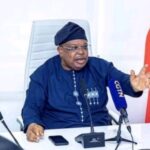



A retired judge and senior members of the bar have joined the Nigerian Bar Association in condemning judicial interference in the internal affairs of political parties, warning that lawyers and judges who flout the Electoral Act 2026 risk sanctions. The rebuke comes as legal and political actors spar over Section 83 of the new law, which expressly bars courts from entertaining suits on intra-party disputes.
In a press release titled “Our Laws And Democracy Must Be Protected At All Times,” NBA President Mazi Afam Osigwe, SAN, said the association is alarmed by recent attempts to drag courts into political party matters despite clear statutory prohibitions. “We particularly deprecate the disturbing involvement by lawyers and courts in the internal affairs of political parties despite the clear provisions of the Electoral Act, 2026, which stipulates in Section 83 of the Act that ‘No court in Nigeria shall entertain jurisdiction over any suit or matter pertaining to the internal affairs of a political party’,” Osigwe stated.
Section 83 (5) of the Electoral Act 2026 provides that no interim or interlocutory injunction shall be entertained by any court in such cases, and that rulings must be reserved for final judgment with accelerated hearing. It further imposes mandatory costs of not less than ₦10,000,000 on counsel who file such actions and not less than ₦10,000,000 on the plaintiff or applicant, plus any costs and solicitors’ fees incurred by INEC where it is joined.
Human rights lawyer Femi Falana, SAN, stressed that the law leaves no room for injunctions at the preliminary stage. “No court in Nigeria shall entertain jurisdiction over any suit or matter pertaining to the internal affairs of a political party… Where such an action is brought in negation of this provision, no interim or interlocutory injunction shall be entertained by the Court, but the Court shall suspend its ruling and deliver it at the stage of final judgment,” Falana said, adding that the provision is designed to prevent intra-party matters from overwhelming the judiciary.
The NBA warned that lawyers who file actions intended to procure judicial interference in intra-party affairs, or who seek ex parte orders in violation of the Act, will face disciplinary proceedings. “We will not hesitate to present petitions before the Legal Practitioners Disciplinary Committee (LPDC) against any legal practitioner found to be engaging in such conduct,” the NBA said. It also called on the National Judicial Council to sanction judges “who knowingly assume jurisdiction” in matters clearly barred by law, insisting that “the Nigerian judiciary must stay vigilant and resist being drawn into political theatrics”.
Echoing the NBA, a retired judge who spoke on condition of anonymity decried what he called “forum shopping and malafide applications designed to secure undemocratic political advantage,” arguing that some rulings have undermined party autonomy and the intent of the Supreme Court, which has repeatedly held that courts should not meddle in political party leadership and convention matters. The PDP Caucus in the House of Representatives similarly urged the NJC to caution judges, citing a recent Federal High Court ruling that refused an interim injunction to stop the PDP’s national convention but went on to make orders that “negate the benefits of his ruling”. “We are deeply concerned that in spite of repeated Supreme Court pronouncements against judicial interference in the internal affairs of political parties, some judges continue to make themselves available as instruments in the hands of desperate politicians,” said Rep. Fred Agbedi, leader of the PDP caucus.
Not all senior lawyers agree with the Act’s sanction regime. Chief J. S. Okutepa, SAN, has criticised Section 138 of the Electoral Act 2026, which imposes penalties of not less than ₦5,000,000 on counsel and not less than ₦10,000,000 on petitioners for filing election petitions on grounds outside those provided by law. He argues the provisions are “excessive, intimidatory, and capable of discouraging legitimate electoral challenges,” calling on the NBA to defend the rule of law and ensure legislative compliance with constitutional standards.
Prof. Chidi Odinkalu, former Chairman of the National Human Rights Commission, took a different view, saying the problem is not the law but its interpreters. “What exactly is wrong with Electoral Act 2023? The judges gutted it. They’ll do the same to the next. What u need to reform is not elections; it’s judges and SANs!” Odinkalu wrote, contending that judicial rulings have overturned electoral results in ways that contradict the spirit and letter of the law.
The Electoral Act 2026 also mandates INEC to keep records of all registered political parties, seek clarifications from party officials at any level, and impose fines of up to ₦1 million on parties that fail to comply with lawful directives. The NBA reminded lawyers that they are “ministers in the temple of justice and not political agents seeking judicial endorsement of partisan objectives,” and urged INEC to exercise its supervisory powers with neutrality. “The Commission must not, under any circumstances, be perceived as a participant in political engineering,” the NBA warned.
With the 2027 General Elections approaching, the NBA said these developments raise “serious constitutional, democratic, and rule-of-law concerns that require immediate intervention,” adding that courts are precluded from granting any interim or interlocutory injunctions in such matters.