


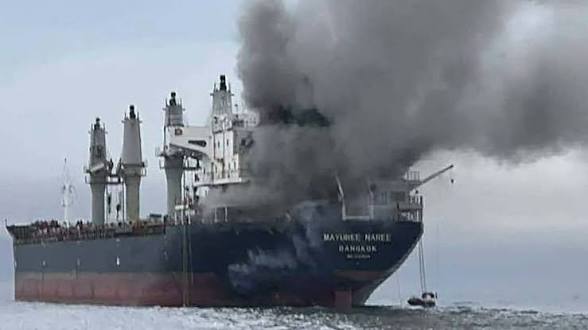
Israel has warned Iran of retaliation following an attack on two tankers in the Strait of Hormuz, as tensions escalate amid a US-led naval blockade and ongoing conflict between Iran, Israel, and the United States.
The warning comes after two Indian-flagged tankers came under attack by Iranian security personnel while transiting the Strait of Hormuz, a key route for global oil and gas shipments. The vessels reportedly had clearance and were caught amid confusion about the strait’s current status.
India lodged a protest with Iran over the firing at the two Indian-flagged ships. India summoned the Iranian ambassador in New Delhi following the incident. The Foreign Secretary conveyed “deep concern” over the firing and emphasised the importance of safety of merchant shipping and Indian mariners. He recalled Iran’s earlier role in facilitating safe passage of India-bound vessels and urged Tehran to ensure safety of ships and resume smooth transit through the strait. The Iranian envoy undertook to convey India’s concerns to authorities in Tehran.
The Strait of Hormuz has been at the centre of escalating confrontation. US-Israeli strikes on Iran in late February sparked a region-wide war and brought to a near standstill traffic through the waterway. US President Donald Trump announced that the United States Navy would begin blockading any and all ships trying to enter or leave the Strait of Hormuz. “Effective immediately, the United States Navy, the Finest in the World, will begin the process of BLOCKADING any and all Ships trying to enter, or leave, the Strait of Hormuz,” he said.
Trump warned of severe retaliation, adding, “Any Iranian who fires at us, or at peaceful vessels, will be BLOWN TO HELL!” He also said Iran’s navy was “completely obliterated” except for a smaller group of “fast attack ships,” and warned that any such vessels coming near the blockade would be “immediately eliminated.”
The US military reported turning back 10 vessels attempting to sail out of Iranian ports during the initial 48 hours of its naval blockade against Iran. US Central Command stated in a post on X that ten vessels have now been turned around and zero ships have broken through since the start of the US blockade.
Iran reverted back on its decision to open the Strait of Hormuz, blaming the US decision to continue with its naval blockade. Iran has called the US move “piracy” and warned that if its own ports are threatened, “no port in the Gulf region will be safe.”
Israel’s Prime Minister Benjamin Netanyahu said the ceasefire “could end quickly,” while Tehran accused Washington of wrecking the Islamabad talks just as an agreement was within reach. Iranian Foreign Minister Abbas Araghchi said Iran had engaged “in good faith” and was “just inches away” from an “Islamabad MoU” before encountering “maximalism, shifting goalposts, and blockade.”
France and Britain said they will work on a “peaceful multinational mission” to restore traffic through the Strait of Hormuz but it would be “separate from the warring parties,” French President Emmanuel Macron said. UK Prime Minister Keir Starmer said the effort would begin “as soon as conditions allow” and aims to ensure freedom of navigation amid repeated threats from Iran.
The British military said a container vessel was attacked near the Strait of Hormuz. The military’s United Kingdom Maritime Trade Operations center said an unknown projectile hit the vessel, 25 nautical miles northeast of Oman. Some containers on the vessel were damaged. It is the second such incident in a week, raising fresh concerns about maritime security in the region.
The human cost of the wider conflict continues to mount. Israeli attacks have killed at least 2,294 people in Lebanon since March 2, including 274 women, 177 children, and 100 health workers and rescuers.
Analysts warn that the blockade could be viewed as a continuation of hostilities, increasing the risk of further escalation, including potential strikes on energy infrastructure with far-reaching global consequences.