

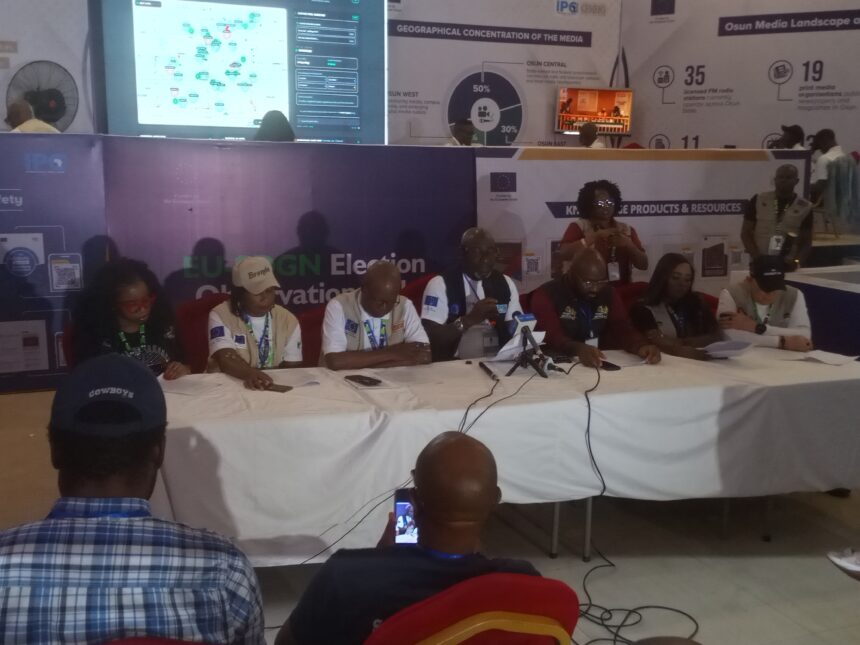
OSOGBO — The European Union Support to Democratic Governance in Nigeria Election Observation Hub, EU-SDGN EOH, has reported an impressive voter turnout and largely peaceful conduct in the Osun State off-cycle governorship election held on Saturday, August 15, 2026, while flagging concerns over BVAS malfunctions, vote buying and voter intimidation.
In a preliminary statement issued at 2.00 pm, the Hub said it deployed 823 accredited observers to polling units across the 30 Local Government Areas to monitor the process using a triangulated methodology that covers election integrity, security, disability inclusion, gender participation, misinformation tracking, media access, journalists’ safety and results verification.
The election is being conducted in 3,763 polling units and is contested by 15 candidates sponsored by 15 political parties. Of the 2,339,233 registered voters, 1,906,390 representing 81.50 percent collected their Permanent Voters Cards and are eligible to vote.
On the opening of polls and accreditation, the Hub said that out of the 823 polling units observed, polling officials with complete complement of both sensitive and non-sensitive materials were present in 726 polling units. Officials with full materials including ballot papers, result sheets, BVAS, voting cubicles, registers, stamps and ink pads were present in 608 polling units representing 83.7 percent between 7.30 and 8.00am. Poll officials arrived at 75 polling units representing 10.3 percent between 8.00 and 8.30am, and at 42 polling units representing 5.7 percent between 8.30 and 11.00am. One polling unit was yet to open as of 11.00am due to non-arrival of personnel and materials.
On the functionality of the Bimodal Voter Accreditation System, observers reported that 58 devices representing 7.9 percent malfunctioned out of the 726 polling units observed. However, 41 representing 70.7 percent of the 58 devices were rectified and accreditation resumed.
“The Hub observers reported that voter turnout was impressive and they were mostly peaceful and orderly with the deployment of effective crowd control measures by election officials and security personnel,” the statement said.
On election security, the Hub reported an average of three security personnel deployed in observed polling units. While most exhibited professional conduct, there were reported cases of voter intimidation by security agents at PU 29-10-10-005 at Igbon D.C. School in Ejigbo, PU 29-26-01-002 and PU 29-30-06-015 at an open space opposite No 22, Oke Ola Street, Okanla Area, Osogbo.
On participation of women, persons with disabilities and other vulnerable groups, the Hub said the process was largely inclusive. “The turnout of women is at about 59% in the observed polling units and more than 70% PwDs turned up to vote in the 12 designated PwD polling units observed. Furthermore, women constituted 36% of polling officials and played significant roles as polling agents.”
On electoral offences, the Hub said that as at 12 noon, observers recorded 38 security incidents, comprising 25 reported cases of thuggery, 12 attacks on electoral officials and 9 cases of voter intimidation by security personnel.
Of the 726 polling units observed, there were 323 cases of electoral offences and irregularities including vote trading (103), multiple voting (12), inducement of polling and security officials (28), campaigning at polling units (38), voter impersonation (14), misconduct by election officials (7), obstruction of voters (31) and exposure of ballot papers (85).
On access for observers and media, the Hub said the environment was generally conducive with no major incident of impeded access. Its fact-checkers detected and fact-checked about eleven false claims relating to alleged payment of INEC officials, arrests by the police and underage voting, among others.
The Hub made several recommendations. It urged INEC to get personnel and materials to polling units yet to open, deploy RATECH and backup BVAS where devices failed to capture biometrics, paste Form EC at each polling unit and immediately upload EC8A to IREV, and monitor priority voting for elderly, pregnant women and PWDs.
It called on security agencies to maintain professionalism, keep a visible but restrained presence, monitor critical risk areas during counting and collation, support EFCC/ICPC officers working polling units to catch vote-trading, and escort election personnel and materials.
Political parties were urged to focus on lawful observation, abstain from vote buying, and pursue grievances through the tribunal.
The media were advised to “refrain from announcing results until INEC’s official declaration” and to stick to real-time fact-checking.
Voters were told to “vote independently; decline any inducement and report vote-buying to INEC staff, security, or an accredited observer on the spot rather than staying silent.”
The Hub said its observers remain deployed at polling units and collation centres and will continue to monitor counting, collation and transmission of results. A Post-Election Report will be issued after the declaration of results.
“The Osun State Governorship Election of 15th August 2026 is a critical test of the new electoral legal framework and a bellwether for the 2027 General Election,” the statement concluded.
The preliminary statement was signed by Centre for Media and Society, CEMESO, International Press Centre, IPC, Nigerian Women Trust Fund, NWTF, TAF Africa, The Kukah Centre, TKC, and Yiaga Africa.