


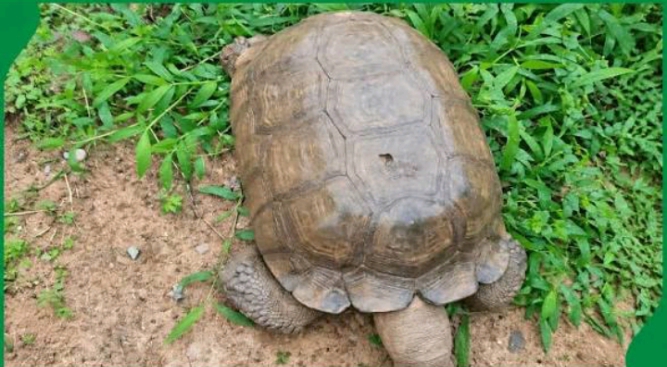
OYO — The ancient town of Oyo is mourning the loss of its oldest and most famous animal resident.
Baba, a giant tortoise believed to have lived for 420 years inside the palace of the Alaafin of Oyo, died on Monday after a brief illness.
The tortoise, known across Yorubaland as the oldest living animal in the region, was a central figure in the palace and a living link to the history of the old Oyo Empire.
The Director of Media and Publicity to the Alaafin, Bode Durojaiye, announced the death in a statement issued in Ibadan on Thursday, September 18, 2026.
He said Baba fell ill on Monday, stopped eating and died quietly later that day. The tortoise has since been buried within the palace grounds.
“In Oyo, Baba was regarded as the oldest indigene,” Durojaiye said.
“It was the Alaafin’s most besotted pet. The incumbent paramount ruler met it in the palace, as Baba was nourished by a succession of kings, who inherited him as part of the relics of their ancestors,” he said.
Durojaiye said the incumbent Alaafin, His Imperial Majesty Iku Baba Yeye Oba Abimbola Akeem Owoade I, met Baba in the palace on ascension.
According to palace oral history, Baba was brought from Oyo-Ile, the ancient capital of the Oyo Empire, to the present palace in Oyo town.
The palace said for centuries Baba was cared for by a line of kings, with two dedicated palace officials assigned full-time to monitor his health and daily routine.
His favourite foods included watermelon, leafy grass and corn pap wrapped in leaves.
Over the decades, Baba became a major tourist attraction. Thousands of local and foreign visitors travelled to the ancient palace specifically to see him because of his impressive size, friendly personality and unbelievable age.
“People were so fond of his fatherly age that no one used a regular name for him; they simply called him Baba, which means father in Yoruba language,” Durojaiye said.
“Baba was more than a turtle in status. He represented a part of the oral history of the Yoruba race. Now, the Alaafin has lost an ageless companion,” he added.
He noted that unlike famous Yoruba legends where royal animals were expected to die alongside their kings, Baba survived many different monarchs.
The palace also disclosed that His Imperial Majesty plans to preserve the animal to give it a chance to remain for another century.
“While he was alive, Baba was more than a diapsid. He was arguably the oldest living mammal in the world. He was venerated, loved by the people, who turned his abode in the palace to a tourist point,” the statement said.
“Baba, the turtle, must have drawn its name from the fact that it was the oldest creature. No one could call him by his name, so Baba was adopted, indicating that it was a male. He drew his own crowd. Strong and friendly, Baba was the reason many people trooped to the ancient palace in his days,” it added.