


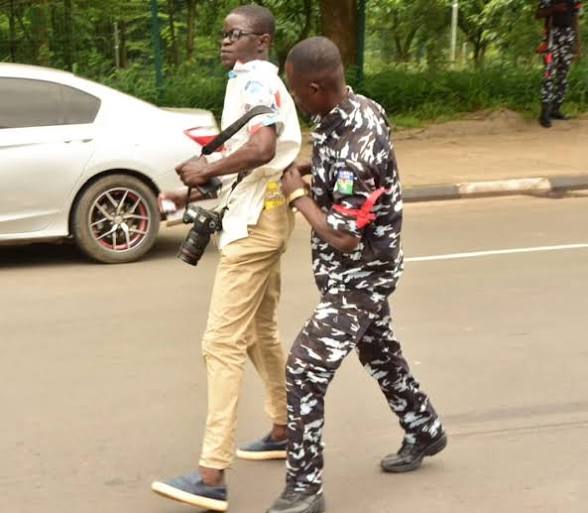
The ECOWAS Community Court of Justice has held the Federal Republic of Nigeria liable for violating the rights of journalist Jide Oyekunle and ordered the government to pay ₦10,000,000 in damages for assault, unlawful detention and seizure of his mobile phone.
The landmark ruling in Suit No. ECW/CCJ/APP/29/25 was secured by Avocats Sans Frontières France, Lawyers Without Borders France, on June 22, 2026, under its eRIGHTS project supported by the European Union. The case stems from August 1, 2024, at Eagle Square, Abuja, where Oyekunle, former Chairman of the Nigeria Union of Journalists FCT Correspondents’ Chapel, was physically assaulted, unlawfully detained and had his phone seized by police while live-reporting the nationwide ‘End Bad Governance’ protests.
The Court found that Nigeria’s actions suppressed his live coverage, breaching his right to freedom of expression under Article 9 of the African Charter. It also ruled that the assault and detention violated his rights to personal liberty, human dignity and freedom from degrading treatment under Articles 6 and 5, while the temporary seizure of his phone violated his right to property under Article 14. The Court further held that Nigeria’s justification failed the test of necessity under international law, making the security forces’ conduct excessive and unlawful.
“This Judgment sends a clear message that a journalist’s digital tools are extensions of the modern press and newsroom, and their arbitrary confiscation by security forces is a direct assault on the public’s right to know,” said Angela Uwandu Uzoma-Iwuchukwu, Country Director of Avocats Sans Frontieres France in Nigeria.
The Court’s pronouncement adds to growing jurisprudence from the regional court protecting journalists and human rights defenders who document protests and public interest events. ASF France said it will continue to monitor compliance with the judgment and provide legal aid to journalists facing similar violations.
For Avocats Sans Frontières France and the eRIGHTS project partners, the ruling fortifies legal protections for journalism in the digital age. It shields reporters from tech-based censorship and intimidation, puts security agencies on notice that targeting media during protests will attract accountability, and reaffirms the ECOWAS Court as a vital shield for civic space in the region.